


Hello everybody. It’s been a while. I’ve been steady preparing the next episode of Enemy, at the expense of keeping up the exclusive content on the Substack, so to those of you who expected more, sorry. Last year, I churned out ~200 pages of a long series on the history of slavery, which I think was pretty good, but keeping up that pace meant it took me 7-8 months to get the history podcast out (a fact about which many of you voiced your displeasure, just as some of you express it now at the lack of exclusive Substack content). Well, I want to keep up a pace of putting out a new history podcast episode every few months, at least until this World War 2 series is done, so that’s where my focus has been. Still, I can’t leave you guys hanging completely, especially considering that my cats will starve if you cancel your subscriptions (very few of you have, despite my slower output, which is amazing, and thank you, but rest assured my guilt over it often has me sweating through soaked sheets, eyes wide open toward the ceiling as I lay in bed at 3 am on a Wednesday). Well, I decided to dial back the history episode work this week to write something that’s been on my mind lately. It’s a typical Martyr Made piece, I think: meandering, disjointed, with thesis that are often disconnected and probably contradictory, but we cover a lot of ground and go some fun places.
The inspiration for this post comes from a book written by a friend of mine, Brian Francis Culkin, called Postscript on Boxing: The Human Body, Virtual Worlds, and Boxing’s Living Dead. He’s a brilliant guy, an Irish kid (if the name didn’t clue you in) and boxing aficionado, and if you want more after reading this essay, I encourage you to check out his book. It’s more theory-heavy than this essay, but it’s much deeper and has a lot of local flavor I couldn’t cram in to a 15-page piece like this.

It can be hard to remember how big boxing was in its heyday. Up through World War 2, it was one of the Big 3 sports (with baseball and horse racing), and the heavyweight champion was the most significant sports celebrity in the world. Even up through the early ‘80s, and briefly during Mike Tyson’s championship run later in the decade, it was still a cultural fixation on the level of other major sports. It’s an important part of the American story, and, much like the history of organized crime or local politics (though I repeat myself), a useful way to read that story “from the bottom up.” The story of American boxing is one of successive waves of immigrants fighting their way into the American mainstream, backed by the fervent support of the ethnic neighborhoods they represented. Before the Second World War, it wasn’t uncommon to see Jewish boxing champions (even a heavyweight champion, briefly, in the 1930s). During that same era, Jewish mobsters matched the Italian mafia in size, reach, and ferocity. American Jews have moved up in the world, out of the social class that historically produced professionals of violence (legal and illegal), and the America that produced Max Baer and Lepke Buchalter seems almost too different to have ever been real. In the old days, most boxers came up on the streets of America’s big cities, where working-class black and Euro immigrant communities rubbed against each other, fighting for space, status, and jobs in heavy industry. From 1926 until the early 1960s, the heavyweight title was held by an almost uninterrupted string of second generation immigrants from Europe and African Americans who made the Great Migration out of the rural South into the industrial cities. By the early ‘60s, Irish, Italian, Jewish and other immigrant groups were on to their 3rd or 4th generation living in the US, and were being driven out of the cities into the suburbs by the social blight and urban decay that resulted from the black migration. Out in the ‘burbs, their kids no longer roamed the streets and alleyways with their coethnics, ready for trouble with rival groups. Fights were rarer, and they were more severely punished: fighting was something done by the blacks and white trash townies we left behind, suburban parents told their kids, not by respectable people like us! While champion boxers were world famous, boxing itself was seen as something for the lower classes, and newly middle-class parents were loath to let little Timmy take it up, even if there had been any boxing gyms in the suburbs (there weren’t). Blacks from America’s big cities (some born there, some moved as kids) did not follow their immigrant neighbors outward and upward, but remained packed into tough lower- and working-class urban neighborhoods, and as a result they dominated the ranks of heavyweight boxing from the 1960s all the way up until the Russian/Eastern European invasion that began with the Klitschkos in the early 2000s.
Due to the limited weaponry (fists only) and small target (head and body), boxing is a highly structured and specialized sport. Mixed martial artists have recourse to every bodily weapon except the headbutt, as well as wrestling and submission holds, and the areas of the body protected by the rules are small and few: no eyepokes, no shots to the groin, the spine, or the back of the head, no small digit manipulation (you can’t grab an opponent’s finger or toe and snap it off), and that’s pretty much it. While the three decades since the first Ultimate Fighting Championship have taught us a lot about what works and what doesn’t, there are enough ways to win that styles are still quite diverse. There are champion kickboxers whose only concern with ground fighting is how to avoid it (Alex Pereira), great wrestlers who almost exclusively use striking to close the distance and get a takedown (Khabib Nurmagomedov), and great submission fighters who practically dare their opponents to take the fight to the ground (Charles Oliveira). Not so in boxing. There are variations in emphasis - power punchers, technicians, cardio monsters, tall guys who feature the jab, etc - but in general boxing was pretty much solved by the 1930s or ‘40s. Don’t get me wrong, there has been some evolution of the game. Modern training methods, nutritional science, and supplementation have improved athletic performance in all sports, including boxing, and that inevitably changes how people fight. Changes in the rules (e.g., moving from 15 round fights to 12 rounders) and adoption of different equipment (e.g. glove size) also affects which styles are optimized for the sport. Still, go watch old videos of Sugar Ray Robinson, and you’ll see guys fighting much the same way they fight today.
Anyone who has ever trained in boxing, especially if they began as an adult, can tell you that the early days are rough. Everything feels unnatural, the body is tight and often wants to do the wrong things at the wrong time. You even learn that you don’t actually know how to walk and have to learn “footwork” from scratch. Everything feels regimented, artificial, imposed… because it is. Boxing coaches take the wild aggression and physicality that walks in off the street, harness it, yoke it to a very specialized, highly-structured purpose.
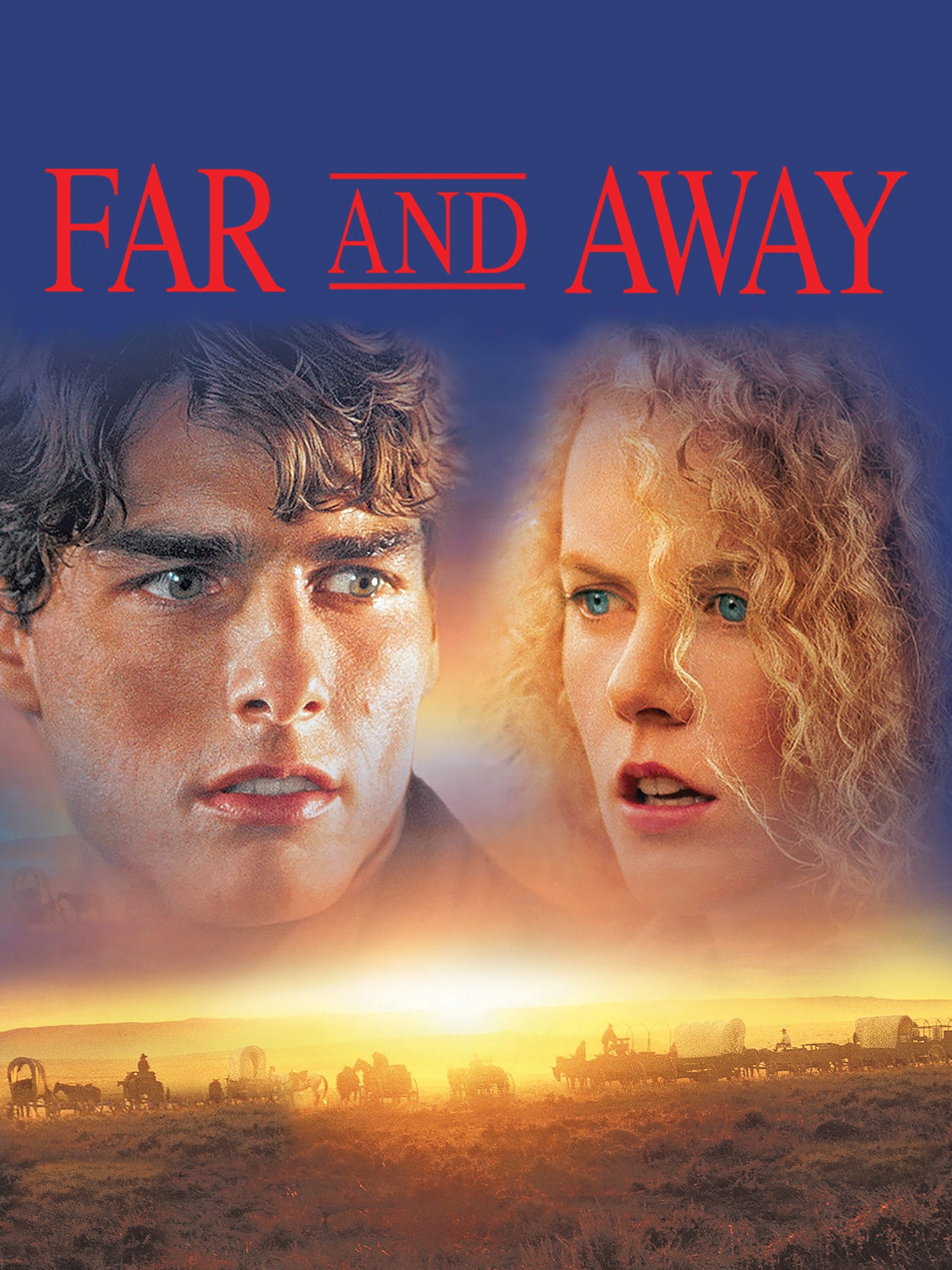
Author Brian Francis Culkin brackets the beginning and end of this American story of immigration, boxing, and industry with two films: Far and Away, and Fight Club. Between these two bookends, I’d like to add Rocky (with Sly Stallone), and The Fighter (with Mark Wahlberg and Christian Bale).
Far and Away
This 1992 Ron Howard film tells the story of Joseph Donnelly (played by Tom Cruise), a 19th-century Irish peasant who immigrates to the United States. Failing to find consistent work, the tough Donnelly makes ends meet by duking it out in bars, warehouses, and basements as an underground bareknuckle boxer. There were house rules, illegal gambling, and the line between regulated contest and criminal violence was blurry at best. Boxing underwent an image makeover in the last decade of the 19th century, but even then it was still largely regarded as a barbaric spectacle unworthy of being called a “sport,” and drew interest and participation only among the vulgar, debased, and criminal-minded. To underline the unregulated nature of the game, the ring announcer in Donnelly’s first fight is a young boy, and before the match is over Donnelly scraps with audience members as well as his opponent.
The seething, pulsing immigrant underclass of which Donnelly was a part was the raw material being fed into America’s industrial machine, trading years off their lives in exchange for bread and a roof. In the mid-19th century, the average life expectancy of an Irish immigrant dockworker in Boston was just 14 years from the day he stepped off the boat. And these were young guys. The slums in which they dwelt were seen by the natives as anarchic black boxes, teeming with half-developed human beings whom it was the burden of the more respectable classes to civilize. Children were herded into schools where drilling and repetition were the order of the day, while their fathers were herded into factories where activity was minutely monitored and measured in seconds. Failure to conform to the strict discipline of either environment doomed one to destitution, even deportation. Just four years after the Statue of Liberty went up in New York City, the frontier was closed, as railroads and telegraph lines networked American politics, commerce, and military power from coast to coast, and the country was about to embark upon its era of overseas empire. The “wretched refuse” of Europe would soon be asked to man battleships, march in formation, and operate assembly lines to drive America’s ascent to the status of a great power. It was no easy task to turn the world’s “tired… poor… huddled masses” into efficient workers, but it was a simple one. As was the fashion in child rearing at the time, it came down to discipline and control. This was a society-wide obsession, from the factory floors being revolutionized by the management theories of Frederick Taylor, to the strict classrooms structured on the Prussian model, to the Progressive Movement that sought to transfer democratic power from the hands of the masses into those of scientifically-trained experts.
The unregulated underground prize fights depicted in Far and Away were both a manifestation and a reflection of the conditions in immigrant communities during the rise of America’s industrial era. Following the broader social trend, the Marquis of Queensbury rules of boxing, which standardized everything from allowable blows, round length, ring size, clothing and gloves (both their requirement and their uniformity), sought to bring order to what was seen from above as another example of the rowdy and dissolute life of America’s debased underclass. Boxing was dragged out of the barroom basement onto the factory floor - that is, it was transformed from a chaotic expression of the id into a highly-regulated kind of skilled labor, mirroring the more general experience of the immigrant underclass during this period. Boxing had first been called the “sweet science” by a British writer nearly a century earlier, but only now did it start to become worthy of the name. As the sport was refined, the paths to victory were narrowed down. Of course, there were always exceptional cases in which one of a fighter’s attributes was so dominant - power (Julian Jackson, Deontay Wilder), reflexes (Roy Jones Jr., Muhammad Ali), reach (Lennox Lewis, the Klitschkos) - that it allowed more flexibility in his style, but as these examples show, a dominant attribute had to be truly exceptional in order for a fighter to ride it to the top. In general, boxers converged on a few similar styles with only minor deviations based on an individual fighter’s makeup.
Culkin writes:
The physical dimensions of a proper boxing pedagogy - footwork, strength, punching technique, wind, etc - are not crude tactics that anyone with an appetite for hitting or extreme physical conditioning can easily assimilate and master; they are rather the most subtle inflections of physical energy that then become (through sustained discipline) spontaneous displays of corporeal intelligence… A simple piece of boxing footwork is infinitely more complex and discrete than, for example, learning a proper defensive stance in basketball (and the results of failing to learn infinitely more consequential).
Boxing is not a game, it is a discipline - it is labor. Historically, quality boxers do not tend to emerge from among the inhabitants of the ghetto underclass, whose lives are often too disordered to sustain the necessary discipline over time.1 Boxers traditionally emerged from the precarious lower end of the industrial working class - tough people, acquainted with hardship, but workers, people who took for granted, and whose fathers and uncles and brothers and cousins took for granted, that in order to survive a man had to get up every day, submit to the discipline of labor, and get to work. When the factories closed down, so did the culture that fostered and supported American boxing, at least in the big cities.
The identity between boxing and work has always been right there on the surface of fights. In the labor obsessed language of the fight world, fighters work the body, outwork an opponent, impress the judges with a good work rate, display good habits in the ring. The identity between boxing and work also persists in the bodies of fighters and the traditional training regimens that produced them.2
The Industrial Revolution was the penultimate act in the history of technological development, which is the story of the deliberate elimination of the need for human muscle power. The lives of hunter-gatherers and early horticulturalists were limited by the rate at which their own bodies could consume and expend calories. Their own physical effort was the fuel that powered their lives, and the potential energy of a bent bow, a spinning sling, or a set trap were the only force multipliers to which they had access. Animal husbandry, and the invention of the yoke, bridle, and plow, allowed people to harness the much greater muscle power of oxen and other stock animals. Planters covered more area with deeper furrows in less time than ever before. Over time, people began to form dense communities around lowland river valleys, especially those at lower latitudes (where year-round sunshine allowed continuous cultivation) and surrounded by deserts (which protected the settlement from marauders and discouraged residents from leaving). Highland rivers tend to race downhill, carving canyons on relatively straight trajectories, but, as they approach their lowland estuaries, many rivers slow to a crawl, meandering in wide curves and providing water to a much greater area. Lowland rivers also have the advantage of being navigable over long distances, greatly reducing the energy cost of transporting cargo, which allowed, for example, the establishment of mining towns, military outposts, and other settlements in regions that could not have produced enough food on their own to be sustainable. Workers, soldiers, administrators, and other human resources could also be easily transported to wherever they were needed, which in turn allowed a society to control and cultivate even more land. For most of history, transportation and communication were a great bottleneck that limited social scale, and navigable rivers provided one of the first great advancements in how humans could organize themselves. This is why the earliest civilizations in Mesopotamia, Egypt, and India originated in exactly these conditions. The Yellow River civilization of China was a bit north of the Tropic of Cancer, but otherwise meets all the criteria as well. In these regions, populations multiplied, social, economic, and political forms became more complex, and these civilizations’ power and influence stretched out beyond their population centers.
While cultivated fruits, nuts, and vegetables brought color to the dinner table, then as now the baseline caloric source for every society was grain. The problem with grain is that it’s neither pleasant, satisfying, nor particularly healthy to eat right off the stalk. People used to grind their wheat into flour by hand. We moderns have difficulty really wrapping our heads around how much effort our very recent ancestors spent on tasks that cost us very little time or energy. Before the Industrial Revolution, a housewife would typically spend 10-20 hours a week just doing laundry. Just getting started meant hauling water from a well or pump, which in rural areas could mean quite a hike. You’ve probably carried a five-gallon bucket of water, and if so then you know it sucks. Imagine doing it every time you needed to wash clothes, take a bath, or clean the house. It was not uncommon for premodern villagers to spend 12-15 hours a week just hauling water. Even people with a well on their own property had to go out to fill their buckets 4-6 times a day, then carry the water to where it was needed. I planted some trees at a spot near my house that is too far to reach with a hose. Young transplanted trees need to be watered during the summer months for the first couple years, so twice a week, I would fill six five-gallon buckets with water from one of our yard hydrants, load them into the back of the truck, and drive around watering the trees. I gotta say, it got pretty damn old after a while real quick, and that was with a truck and a pump I didn’t have to operate by hand. It’s almost impossible not to take it for granted, but I find it very profitable to reflect, from time to time, on the labor from which I’m freed just by being able to turn a faucet and have a virtually endless stream of hot water come spilling out: hauling water, gathering fuel, starting a fire, heating the water… In the old days, people were never bored because it took so much work just to stay clean, fed, watered, and sheltered.
The development of human civilization has been the record of our progress at harnessing and using energy sources. Animals, rivers, wind, hydrocarbons… Almost all energy available on Earth comes from the sun. Sun shines down onto photosynthetic plants, which are eaten by animals and metabolized into the energy needed to do things like pull a plow or carry a bucket of water. Sometimes we eat the animals that eat the plants, and use the energy stored in their meat to do other things. The same photosynthetic process grows trees, which store up energy that can be liberated and put to use by burning. Rivers flow downhill, so we could say that gravity provides the energy, but the rivers would have long ago settled at a common level in the oceans if not for the sun causing evaporation, cloud formation, and upriver rain that renews the process. The sun’s heat, combined with the spinning motion of the earth, creates disparities in air temperature and pressure, which creates wind as the atmosphere seeks an unattainable equilibrium. There are a few other sources worth mentioning - geothermal, the kinetic energy of water bodies being pulled by the gravity of the moon, etc. - but it’s no wonder that the sun was probably the most widely-worshiped god in the ancient world.
None of these means of converting sunlight into the energy needed to grind flour or bake bread are particularly efficient. At every step in each process, there is loss along the way, and the easiest way to visualize it is to take a look in the toilet next time you use the bathroom. That’s still organic material laden with energy, which is why we spread it over our fields to fertilize them. The sun shines, rivers flow, and wind blows whether or not we take advantage of them, and most of the major advancements in human life have come when we’ve learned to put one of them to a new use. A flowing river carries tremendous energy that will be there whether or not we take advantage of it. A few men navigating a barge down the Euphrates could do the work of hundreds of humans or draft animals moving on land. Around the 4th century BC, some genius figured out another way to harness the energy carried by a flowing river when he invented the water wheel.

Now the river turned a wheel, which powered a contraption that could grind grain into flour 24 hours a day, 7 days a week. Instead of a typical family spending 1-3 hours grinding the flour needed for the day’s bread or porridge, farmers brought their crops to the miller, who in turn sold or traded the flour produced by his mill to others. This did more than just free up hours of the day, it also drove economic development and specialization, as households sought the means to acquire through trade goods they’d formerly produced themselves. Little did they know it, but they were well on their way to global capitalism.
Until the sixth or seventh century AD, the only societies with elaborated economic and social forms, surplus and specialized labor, and life much beyond subsistence, existed along rivers. Then people figured out how to drive a mill using wind, which allowed us to sustain communities in regions other than river valleys. The advent of windmills, and the desire to improve their capacity and efficiency, soon led to improvements in the design of ship sails, which made deepwater navigation safer and easier. Deepwater navigation allowed trade goods to be transported across vast distances that had previously required lengthy caravans and countless middlemen. Buyers had access to more goods than ever before, and sellers had access to larger markets. Soon ships were circumnavigating the globe, carrying goods, people, and information to every corner. Colonial empires were established to exploit the resources of undeveloped lands. The old imperial model was purely extractive, and populations were seen as human resources to work in mines, on plantations, or in other ways to extract material resources - sugar, ore, spices, etc. - which could be traded around the world for gold and silver. By the mid-18th century, however, a different idea had begun to dawn in Britain. Here was an island nation that specialized in maritime travel, controlled well-developed colonies in North America, and had recently added the jewel of India to its imperial crown, giving it access to vast markets for manufactured goods and the seapower to deliver them. The Industrial Revolution began in Britain because it began to see its colonies primarily as markets, and their colonial subjects as customers, for goods manufactured in the British homeland. The products that powered the early stages of the revolution were textiles: wool, linen, and soon, predominantly cotton. A series of inventions in the early 1700s allowed textile manufacturing to be centralized and sped up, just as the wind and water mill had centralized and sped up the grinding of flour, and with similar results: something that had always been a household chore done by hand was outsourced to operations harnessing environmental energy to drive the process.
In the beginning, textile mills were powered by the same source that had revolutionized grain processing in the first millennium BC, and provides electricity to many of our great cities today: the flowing river. There’s nothing magical about it, and yet it really is quite amazing. I have a little tractor with a set of attachments to accomplish various tasks. A few of them hook up to the Power Take-Off - basically a long axle sticking out behind that tractor. When the PTO is engaged, the axle turns, and various implements can be driven by it. Some, like my brush hog (a big mower that trails behind the tractor), are fairly straightforward: It doesn’t take much imagination to see how the motion of a turning axle could be used to turn a mower blade. But others are downright ingenious. A baler uses the PTO to power a contraption that picks up rows of cut hay, packs them into square or round bales, binds them with twine, then spits out a trail of nicely-shaped bales behind the tractor as it goes. All that complex activity accomplished by the simple turning of an axle!
Wind- and water-based energy operate according to the same principles. Instead of an axle turned by a diesel engine, the earliest mills were powered by water wheels turned by flowing rivers. Thus, the first hotspots of the Industrial Revolution were mill towns located along rivers. Manchester, England had the Irwell and Mersey, and Lowell, MA had the Merrimack. All were navigable to the sea, opening the way for raw materials to be shipped in, and finished textiles to be shipped out. For years, Lowell was the beating heart of American industry, importing raw cotton from the South, and exporting the finished product around the world. The textile industry needed stevedores to load and unload cargo, and sailors to ship it up and down the river. The workers needed groceries, haircuts, furniture and entertainment. A city was being built on the fly, and workers were in great demand just as thousands, then tens of thousands, then millions of Irish immigrants began to wash up on America’s shores. Massachusetts was ground zero for American Puritanism, and had an intensely homogenous Anglo Saxon character, so it was an unlikely place for the Irish to end up. Boston itself had an economy that was not particularly suited to accommodate hordes of unskilled immigrant laborers, so many immigrants moved to Lowell for what were supposed to be temporary construction jobs. When it became clear that many of them intended to stay, the natives initially put up an intense fight to dissuade them. In 1831, the building of St. Patrick’s Cathedral was the occasion for a nasty nativist riot against the Irish newcomers.
The Irish famine of the 1840s sent massive waves of immigrants across the Atlantic, and as Lowell grew the city’s business owners decided they liked cheap Irish labor more than they disliked Irish people. Within a few decades, the city would have an Irish mayor, and Lowell has been thought of as an Irish-American enclave ever since. The immigrants were mostly illiterate peasants whose entire family line back into prehistory had been farmers. They knew how to work hard, but they were used to working at their own pace, stopping for water when they were thirsty, to eat when they were hungry, to rest when they were tired. Their landlords expected a share of their crops, but there were no overseers breathing down their necks to keep them on task. The Irish peasant distrusted authority, and such an attempt to micromanage their workday would likely have resulted in violent insurrection (never particularly far from the surface among the Irish in any case).
Moving from the country to the city meant placing oneself under the discipline of the clock. Moving from the farm to the mill or factory meant exchanging variation with repetition. Farmers work hard when they plow their fields, but once the job is finished it doesn’t come back up on the schedule until the next year. In a given day, a subsistence farmer might sow a field, milk a cow, slaughter a pig, repair a tool, and chase off a predator. A 19th-century mill or factory worker, on the other hand, stood or sat at his station performing the same repetitive task hour-by-hour, day-by-day, for as long as his mind and body held up. The first generation immigrants didn’t even have the advantage, as their children would, of having gone through years of school that trained them to sit still for hours performing tasks on command, responding to bells, whistles, and announcements that told them when to arrive, stand, sit, speak, eat, and leave. Industrial workers are not born, they are made, and they’re made in the same way tough guys are turned into boxers - through the application of frequent beatings (real and figurative). To survive in a boxing gym, you’ve got to show up every day, on time, and submit yourself to the unnatural discipline of your trainers to become proficient in a strictly-regulated, limited domain. Everyone wants to jump in the ring and spar, nobody wants to do road work, to jump rope, to repetitively drill combinations - jab, jab, cross, step, no, not there, there, again, jab, jab, cross, no, mind your head, don’t leave your jab sitting out there, jab, no, tuck your chin. I had been in dozens of schoolyard and street fights, and had trained wrestling and jiu jitsu for years, before I took my first boxing lesson, and it was still mind-numbingly frustrating for at least the first couple of months. I was doing it for fun, but if you want to compete you had better be ready to put on the yoke, because if you go in there winging haymakers at a disciplined opponent who puts in the work, it’ll be over by the time you wake up.
Rocky
Every American knows the story of Rocky Balboa. You know it even if you’ve never seen it. Apollo Creed, the heavyweight champion, needs a fight, but his promoters explain that he has convincingly beaten all the plausible contenders, and nobody wants to see pointless rematches. As a marketing gimmick, they decide to give an unknown Everyman fighter a shot at the belt. The conclusion, of course, is foregone as far as Creed’s team is concerned, but Rocky, the down-on-his-luck journeyman from Philadelphia they choose for the fight, has other ideas.
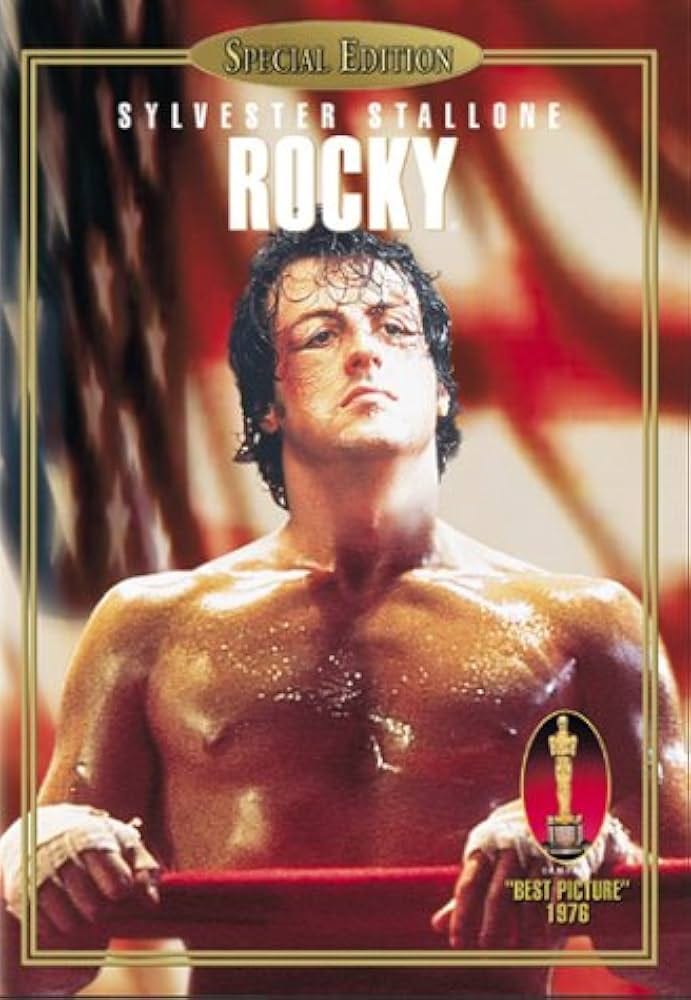
Rocky, an Italian-American living among deteriorating rowhouses and shuttered shops in Kensington, one of Philly’s roughest neighborhoods. Boxing isn’t a career for guys like Rocky, it’s just a job. A self-described “ham-and-egger,” or local club fighter, he fights every few weeks to make ends meet, regularly taking beatings from younger up-and-comers who use punching bags like Rocky to pad their record. Nobody, least of all Rocky himself, has any illusions about what is expected to happen when he fights Apollo Creed.
Rocky Balboa was from a recognizable demographic in mid-1970s America: the downwardly-mobile white ethnic who hadn’t made it out of the city, and was being pulled down by the self-reinforcing cycle of failure that gripped everyone living in these blighted areas.
One of the interesting facts about Stallone’s Rocky is that, by the time it was released, the big cities were no longer churning out champion fighters the way they used to. Rocky himself is an anachronism, a character out of time, in more ways than one. He was born in the last year of World War 2, presumably to a father recently returned from winning it. It was the highest high in American history. White ethnics like Rocky’s parents had never been so prosperous, or so accepted, and anyone predicting the course of baby Rocky’s life would have expected the ascent to continue. Instead, Rocky turns 30 in a city brought low by crime, blight, and deindustrialization. A massive influx of black migrants from the South arrived just in time for three-quarters of the city’s industrial jobs to leave. The surge in violence and property crime, the deterioration of infrastructure, the racialization of local politics, and the destruction of schools and other institutions that resulted from the black migration sent white families with the necessary social and economic capital fleeing their old ethnic neighborhoods for the suburbs. East Coast Italians were tough, territorial, and inwardly-focused, a generation behind the Jews in the assimilation process despite arriving on the same boats. That’s why the Italians still had a strong tradition of organized crime and a heavyweight boxing champion (Rocky Marciano) in the 1950s, while the Jewish mob and Jewish boxing had petered out a decade or two earlier. The point is, the Italians were not people to walk away from a fight, so they stayed longer, and fought harder, than the other Euro ethnics to hold onto their neighborhoods, but they were fighting a lost cause, not least because, unbeknownst to them at the time, they were up against much more powerful forces than the black migrants moving in down the block. As E. Michael Jones writes in The Slaughter of Cities, the destruction America’s urban Catholic enclaves was not happenstance, but policy.3
By the mid-1970s, even most Italians had begun to throw in the towel and decamped for the suburbs. With the factories closed down, the cities no longer needed them, except as cops and firefighters patrolling the old neighborhoods from which they’d been driven. Those who remained, like Rocky Balboa, often stuck around because they had nothing better awaiting them elsewhere, and while they retained certain trappings of traditional Italian-American culture, they no longer belonged to a place, and no place belonged to them. There isn’t much that’s Italian about Rocky besides his look and his iconic nickname. His legendary performances against Apollo Creed are meant to show the victory of an everyday workingman changing the trajectory of his life with raw grit and determination, but while it’s a wonderful, inspirational film, the victory is a bit hollow. After Rocky makes his name fighting Creed, he moves out of Kensington into a lavish mansion, belatedly following the white flight of the people who’d left him behind the first time around. The film works only because a boxer can be a figurative workingman, but never a real one. A boxer, given the right opportunity, can change everything for himself by performing at his best for one night. Beat Apollo Creed, and nothing will ever be the same. The local fans cheering Rocky on are real workers, though, and no amount of grit or determination will change the facts that all the factories are closed down, the construction jobs are taken by low-wage Mexican immigrants, and their kids are being left behind in neglected schools full of violence and drugs.
The Fighter
The Fighter is the story of Mickey Ward, the fighter beloved for the grit showcased in his all-time great trilogy with Arturo Gatti. If you know someone who’s never watched boxing and doesn’t get why it was ever a big deal, show them the Ward-Gotti trilogy. Ward, played by Mark Wahlberg, came up in Lowell, MA, alongside his trainer and half-brother Dickie Eklund, who began his career the same year Rocky fought Creed for the first time. The Fighter reflects today’s more common reality of boxers emerging from post-industrial towns like Lowell, rather than from big cities like Philly. In the earlier era, boys were training to be industrial workers, and some of them took up boxing; when Ward was coming up, boys in post-industrial towns like Lowell weren’t training to become anything, and for some of them boxing filled the gap. Both Rocky and The Fighter are nostalgic films. Made in the mid-1970s, Rocky imagines that American men can still somehow bootstrap their way back to 1945, and get back on the track their fathers were on. The Fighter does not peddle this false hope, but holds out the more modest one that men among the ruins can still earn self-respect, and the respect of their community, by maintaining high character excelling in an activity that means something to people. The film’s antagonist is not so much Ward’s boxing opponents, who come and go without much fanfare, but his daily struggle to avoid being pulled down into the chaos and degeneracy engulfing everyone around him. Neither Ward’s championship run, nor his legendary performances against Gatti, turned him into a mega-celebrity like the fictional Italian Stallion, and neither did being played by Marky Mark in a major Hollywood movie. Ward today has a net worth estimated to be about $500,000, and he’s part owner of a local gym and an outdoor hockey rink. He’ll be fine in a town like Lowell, and his family will be fine, but his net worth is still only about one-third of an average American his age (now sixty). As a fighter, he was workmanlike in the most positive sense, a lunchpail fighter, a fighter who won by outworking his opponents, the very qualities that had once made Lowell great, and on which many Lowell residents still prided themselves, long past the time when the city itself any longer had use for them. The lesson of Mickey Ward’s life and career is that those qualities have value in themselves, and are their own reward.
Fight Club
Men were moulded, generation by generation, into industrial workers, submitting themselves to the discipline of a male-dominated workplace where respect was earned by competence and hard work, and swift punishments were meted out for laziness and irresponsibility. They were hard at work making the lives of common people more comfortable and secure than ever before. No one suspected that they’d be so successful as to soon make their own contributions unnecessary. Today, all but the most degraded socioeconomic classes have access to luxuries unimaginable even a few decades ago. People like to wax nostalgic about how the Boomers grew up in a world where a construction worker with a 10th grade education could support his family on one income, but this always involves some fudging of the numbers. The mythical privileged families of the 1950s and ‘60s typically lived in a 1,200 square-foot house with no air conditioning. There was one single-line telephone, and calls outside the immediate local area were made quickly and rarely because the cost of long-distance calls was prohibitive. The kids shared bedrooms and everyone shared bathrooms. They had one car, and when they went on vacation they piled into it and drove to a modest place upstate. If they went out to eat, it was probably someone’s birthday. When things broke, they were fixed, not replaced, and if they couldn’t be fixed, well…
One of Fight Club’s early scenes takes place in Jack’s apartment. Jack is the narrator, played by Edward Norton, and Jack is not his real name (but those who have seen the film will know why I’m using it). His real name is never given, and somehow this odd fact never seems important. Anyway, the follows the camera through Jack’s apartment into his trash can, maneuvering through the can’s contents, gliding past name-brand consumer detritus. Jack describes how, like many others of his class and generation, he’d fallen victim to the “Ikea nesting instinct,” obsessing over finding the right coffee table to fit his living room, and wondering which dining set best defines him as a person. In any past age, a man Jack’s age, with no kids, no family, no personal connections of any kind, as far as the film’s concerned, would have been a barbarian, a criminal, a sailor, a mercenary, something dangerous, perhaps, but at least exciting. Instead, Jack has been lured by the promise of comfort and safety into a mind-numbingly boring, risk-averse life where nothing bad ever happens, because nothing really ever happens at all. He goes to his bullshit, entirely superfluous job, collects his reward pellets, and scurries home by the shortest route possible to avoid the confusing, unpredictable world outside his door.
Of course, Jack is miserable, hopeless, and, though he doesn’t dare realize it yet, full of rage. Rage that could shoot up an office (Jack threatens his boss with exactly this at one point), and burn down whole cities (Jack and his friends get a decent start on this by the end of the film). Everything changes when he meets Tyler Durden (played by Brad Pitt), who asks Jack, on their first night out for beers, to punch him as hard as he can. Jack has never been hit by anyone, nor has he been hit, and the prospect is as absurd as it is terrifying, but Tyler goads him into it. The punch is predictably pathetic, and Tyler responds by drilling his fist into Jack’s gut, doubling him over in pain. Confronted for the first time in his muddled memory with life’s proverbial brass tacks, something awakens in Jack, and he asks Tyler to hit him again. Soon, they’re fighting, others see them and join in, and something of a cult forms around these two men who seem to have found the answer to a question millions of men sitting in cubicles by day and poring over catalogs by night felt, but never thought to ask. They take up residence in a dilapidated old mansion on the outskirts of a disused industrial zone - literally living in the ruins of the world their fathers built.
In Jack and Tyler’s fight club, the only rules are that fighters wear no shirts or shoes, fights are one-on-one, and the bout is over when someone gives up or goes limp. There are no rounds, no time limits, no structure at all. We’ve returned full-circle to the basement bareknuckle brawls fought by Joseph Donnelly in Far and Away, except that everyone in the audience is a fighter waiting his turn, and nobody expects to get anything out of it except to give and get a beating. The chaotic prize fights and disorderly immigrants in Far and Away are on their way to being bound and codified into an orderly, rules-based society; the fights in Fight Club and the anxious, depressed men who square off have become so over-socialized that their entire lives feel artificial, and all they really want is an outlet for their rage. Culkin writes:
In other words, the fight scenes in Fight Club and the fight scene in Far and Away are nearly identical from their opposite positions in boxing’s historical movement: Edward Norton’s “narrator” character is simply the “negation of negation” of Tom Cruise’s Joseph Donnelly. Joseph Donnelly represents the pre-industrial, pre-globalized Irish peasant who arrives to Boston in mid-19th century America to construct his life. His bareknuckle brawling in the city saloons is apropos of the emerging immigrant boxer yet to be disciplined, the individual yet to be captured by the interrelated logic of industrial production and “scientific” boxing. Whereas Norton’s character represents the post-industrial, post-national peasant who floats through life in a daze, only responding to the pulse of market fluctuations and advertising slogans; he has no home, history, or solid ground to stand on. In near-perfect inversion to Cruise’s Donnelly who is seeking discipline, the bareknuckle brawling of Norton’s character in the basement of a dilapidated mansion is apropos of the contemporary individual who refuses to be controlled: fight club stands in for boxing’s negation of its own positive content. In other words, the negation of boxing in American culture can be ascertained from the continued breakdown of the working class, and the arrival of the disconnected, individuated, debt-ridden white collar worker as replacement.
Culkin does some of his best work when contrasting Far and Away with Fight Club. For example, he points out that the fight promoter in Far and Away is not only a fight promoter, but also a South Boston political boss and power broker. However, Kelly and other Irish-American politicos in his day were not working on behalf of the dominant institutions, but actively subverting the system of Yankee domination “through an informal network of favors, hand shakes, and back room whispers.” That is to say, Irish power brokers like Kelly subverted the system in order to force their way in, while Tyler Durden and his acolytes in Fight Club are subverting it to force their way out.
I’ve remarked somewhere else on a stark difference between the depiction of male and female characters in prehistoric art. Females are usually portrayed naked, often with exaggerated breasts and hips, while males are typically portrayed in costume, usually of animals. That is because women have no need of costumes to understand their destiny or purpose. There are few if any examples of elaborate female rites of passage, because nothing society could devise could be more powerfully instructive than a girl’s first menstruation, pregnancy, and experience as a mother. Nature announces to a woman in unequivocal terms who she is and what she is for. Not so with men. A single man can impregnate an almost unlimited number of women, whereas women can only become pregnant once every year or two (assuming everything goes well). The species could get by with one lucky male for every ten females, but not the other way around. Individual men are almost entirely expendable, as far as nature is concerned, and it goes out of its way to remind us that we are more or less redundant. Society itself is, to a great degree, an artificial construct designed by men to provide meaningful roles for ourselves to play, to make ourselves necessary. In a modern, globalized world in which wealth is generated on spreadsheets and wars are fought by remotely-controlled robots, men are not only genetically expendable, but socially expendable as well. From fight club the manosphere to incels to militant racial and religious factions to the ever-increasing adoption of paganism and deus vult-style trad Christianity, men have resorted to any number of desperate attempts to recreate an imaginary world in which men are still vitally necessary, but despite the often heated rhetoric, few are ready to take seriously the inescapable fact that when men are necessary, it is their capacity for violence and physical hardship that makes them so.
A few prominent counter-examples, most famously Mike Tyson, feed the popular myth of the “hungry fighter” scrapping to survive on the streets until he learns to channel his ferocity in the ring, but even Iron Mike’s discipline turned out to be entirely dependent on his unique father-son relationship to his trainer, Cus D’Amato. Tyson began to fall apart, both in and out of the ring, almost as soon as D’Amato passed away.
From Good With Their Hands: Boxers, Bluesmen, and other Characters from the Rust Belt, by Carlo Rotella
For those interested, Jones does a specific deep dive on Kensington, Philadelphia, Rocky’s native neighborhood
This essay is not really my area of interest, but I thought I'd stop by to reiterate that I'd gladly pay a higher subscription fee rather than see you exhaust yourself to please us. You have a life and a family that need your time as well, so don't beat yourself up over the pace of your output.
Great article. It kinda reminds me of how I am in the middle of getting my garden ready. It is mindless physical labor that leaves me exhausted, but it makes me feel so much more alive than my job does.