


So, is everybody ready to move on from the Jeffrey Epstein story? Haven’t you heard that the Dow is at 50,000? No? Well, I’ve had about my fill of the sordid story, but it seems we have no choice but to see this thing through. There are plenty of people going through the files, speculating about redactions, and making lists, charts, and data visualizers to represent it all. I said most of what I have to say about the topic in my Epstein series, and there are better people to follow than me for deep dives on the personal, financial, and organizational revelations in the recently released files. In any case, I have no doubt that what’s been released only provides a small and probably misleading look at the whole picture, and I’d rather wait until the info dump has settled down to say much about it. Instead, I want to talk about the broader issues at play, and that means finally sharing my favorite schizo theory.

Ursula le Guin has this wonderful little short story called The Ones Who Walk Away From Omelas. She begins by describing an idyllic fictional town and its joyful inhabitants. No one wants for anything. No one is oppressed. Families love each other and communities cohere. It’s the Festival of Summer, and the seaside town is decorated for celebration. Men contentedly put their hands to their tasks, mothers with babies smiled as they chatted with one another in the park. Groups of people dance and play instruments, dressed brightly and trailing streamers behind them.
“They were not simple folk,” Le Guin wrote, “though they were happy. But we do not say the words of cheer much any more. All smiles have become archaic. Given a description such as this one tends to make certain assumptions. Given a description such as this one tends to look next for the King, mounted on a splendid stallion and surrounded by his noble knights, or perhaps in a golden litter borne by great-muscled slaves. But there was no king. They did not use swords, or keep slaves. They were not barbarians. I do not know the rules and laws of their society, but I suspect that they were singularly few. As they did without monarchy and slavery, so they also got on without the stock exchange, the advertisement, the secret police, and the bomb. Yet I repeat that these were not simple folk, not dulcet shepherds, noble savages, bland utopians. They were not less complex than us.”
Then Le Guin makes plain that she is dealing in fantasy, admitting her illustration may not suit every reader, and encouraging us to imagine the town and its people as we would like our utopia to be. We follow the joyous procession near to its end, caught up in the reverie of no place, wilfully ignoring the impossibility of the vision, when Le Guin the dark sorceress reveals her magic.
“Do you believe? Do you accept the festival, the city, the joy? No? Then let me describe one more thing. In a basement under one of the beautiful public buildings of Omelas, or perhaps in the cellar of one of its spacious private homes, there is a room. It has one locked door, and no window. A little light seeps in dustily between cracks in the boards, secondhand from a cobwebbed window somewhere across the cellar. In one corner of the little room a couple of mops, with stiff, clotted, foul-smelling heads, stand near a rusty bucket. The floor is dirt, a little damp to the touch, as cellar dirt usually is. The room is about three paces long and two wide: a mere broom closet or disused tool room. In the room a child is sitting. It could be a boy or a girl. It looks about six, but actually is nearly ten. It is feeble-minded. Perhaps it was born defective or perhaps it has become imbecile through fear, malnutrition, and neglect. It picks its nose and occasionally fumbles vaguely with its toes or genitals, as it sits hunched in the corner farthest from the bucket and the two mops. It is afraid of the mops. It finds them horrible. It shuts its eyes, but it knows the mops are still standing there; and the door is locked; and nobody will come. The door is always locked; and nobody ever comes, except that sometimes-the child has no understanding of time or interval – sometimes the door rattles terribly and opens, and a person, or several people, are there. One of them may come and kick the child to make it stand up. The others never come close, but peer in at it with frightened, disgusted eyes. The food bowl and the water jug are hastily filled, the door is locked, the eyes disappear. The people at the door never say anything, but the child, who has not always lived in the tool room, and can remember sunlight and its mother’s voice, sometimes speaks. “I will be good,” it says. “Please let me out. I will be good!” They never answer. The child used to scream for help at night, and cry a good deal, but now it only makes a kind of whining, “eh-haa, eh-haa,” and it speaks less and less often. It is so thin there are no calves to its legs; its belly protrudes; it lives on a half-bowl of corn meal and grease a day. It is naked. Its buttocks and thighs are a mass of festered sores, as it sits in its own excrement continually. They all know it is there, all the people of Omelas. Some of them have come to see it, others are content merely to know it is there. They all know that it has to be there. Some of them understand why, and some do not, but they all understand that their happiness, the beauty of their city, the tenderness of their friendships, the health of their children, the wisdom of their scholars, the skill of their makers, even the abundance of their harvest and the kindly weathers of their skies, depend wholly on this child’s abominable misery. This is usually explained to children when they are between eight and twelve, whenever they seem capable of understanding; and most of those who come to see the child are young people, though often enough an adult comes, or comes back, to see the child. No matter how well the matter has been explained to them, these young spectators are always shocked and sickened at the sight. They feel disgust, which they had thought themselves superior to. They feel anger, outrage, impotence, despite all the explanations. They would like to do something for the child. But there is nothing they can do. If the child were brought up into the sunlight out of that vile place, if it were cleaned and fed and comforted, that would be a good thing, indeed; but if it were done, in that day and hour all the prosperity and beauty and delight of Omelas would wither and be destroyed. Those are the terms. To exchange all the goodness and grace of every life in Omelas for that single, small improvement: to throw away the happiness of thousands for the chance of the happiness of one: that would be to let guilt within the walls indeed. The terms are strict and absolute; there may not even be a kind word spoken to the child. Often the young people go home in tears, or in a tearless rage, when they have seen the child and faced this terrible paradox. They may brood over it for weeks or years. But as time goes on they begin to realize that even if the child could be released, it would not get much good of its freedom: a little vague pleasure of warmth and food, no doubt, but little more. It is too degraded and imbecile to know any real joy. It has been afraid too long ever to be free of fear. Its habits are too uncouth for it to respond to humane treatment. Indeed, after so long it would probably be wretched without walls about it to protect it, and darkness for its eyes, and its own excrement to sit in. Their tears at the bitter injustice dry when they begin to perceive the terrible justice of reality, and to accept it. Yet it is their tears and anger, the trying of their generosity and the acceptance of their helplessness, which are perhaps the true source of the splendor of their lives. Theirs is no vapid, irresponsible happiness. They know that they, like the child, are not free. They know compassion. It is the existence of the child, and their knowledge of its existence, that makes possible the nobility of their architecture, the poignancy of their music, the profundity of their science. It is because of the child that they are so gentle with children. They know that if the wretched one were not there snivelling in the dark, the other one, the flute-player, could make no joyful music as the young riders line up in their beauty for the race in the sunlight of the first morning of summer. Now do you believe in them? Are they not (now) more credible?”
What’s wonderful about a story like this is that it works at almost any level you feel like playing at. You can read it psychologically, as each of us must subdue the free and naive children we once were in order to survive and remain presentable in the adult world. Politically, every society seems to grease the skids of internal cohesion by projecting its collective hatred onto an Other outside or at the bottom of their polity. Or we could understand it culturally. Every culture has skeletons hiding in plain sight which, stripped of the familiarity we’ve developed for them over a lifetime of close contact and indoctrination, would appear as monstrous as they in fact often are. Secular activists in the West are morally and ethically appalled at the Christian resistance to gay marriage and abortion, but almost nobody seems very concerned about the fact that those Christians all gather on Sundays to worship a victim of torture and execution, and to eat his flesh and drink his blood (and it’s a good thing, because I doubt they’d have the patience to sit through an explanation of how the sublimated symbolic act is what frees us from the impulse to satisfy it literally).
From primitive tribes to great civilizations, human beings through time and across the world have entertained the notion that the universe somehow feeds on suffering, and confers power upon whoever brings it a meal. From Polynesia to West Africa, from Papua New Guinea to the Yucatan, countless creation myths begin with the sacrifice of a god, whose blood must be repaid by ritual reenactments from the human benefactors. The blood-drenched Mesoamerican civilization encountered by the Spanish conquistadors in the 16th century is perhaps the most famous recent example of a society built on human sacrifice.
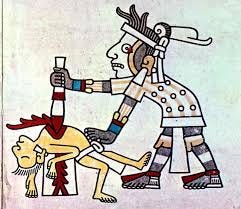
The Aztecs gave blood, their own and that of others, to the gods on an almost unlimited number and variety of occasions. Most have heard something about their “flower wars” with other Mesoamerican towns and cities, during which both sides did their best not to land killing blows on the enemy, but to disable him so that he could be made a captive destined for death on the sacrificial stone. Killing enemies in battle brought a warrior little glory in Mesoamerican societies, but they were greatly rewarded for bringing captives back to the city to die on the sacrificial stone. The Mesoamerican religious calendar was full of holidays drenched in the blood of sacrifice victims, and, at the end of each calendrical cycle, whole cities performed rituals and stood vigil throughout the night to see if they’d given the gods enough blood to persuade them to permit the sunrise and the start of a new cycle. If not, the sun would remain beneath the horizon, and the world would end in a horrific manner with which psychologists would have a field day.
For reasons I laid out in Martyr Made #8 - How to Serve Man, I believe that ritual murder (human sacrifice) had its place in the history of virtually all societies. At one time, ritual murder represented a step toward civilization, since it attaches symbolic meaning to an act which, perpetrated against any other species, would be mere labor, mere butchery. Animals kill and eat, only humans sacrifice and feast. Ritual transforms animal aggression and casual sadism into a conscious act of human will. We have a few examples of societies who seem to have viewed the act of killing (at least killing members of the outgroup) with little more significance than slaughtering a pig, and it’s not pretty. Take, for example, the Tugarian people of New Guinea. Savage, warlike, and gratuitously cruel, they took long canoes along the coast and up the rivers, terrorizing more peaceful villages like stone age Vikings. To ensure a steady supply of food during their months-long raiding expeditions, they brought along captives whose arms and legs had been broken to prevent escape, but who were kept alive so that their meat would stay fresh until it was needed. The Tugarian warriors cut off the prisoners’ body parts as needed, but treated the wounds and tried to keep their mobile meat lockers alive as long as possible. That is one of the more primitive examples of regularized cannibalism you’ll find, but even here the consumption of human flesh was set about with taboos, superstitions, and prophylactic rules.
